
About Hampi — UNESCO Heritage
Hampi was once the capital of the Vijayanagara Empire — one of the richest and largest cities in the world in the 14th-16th centuries. Today, its UNESCO World Heritage ruins spread across 26 sq km of surreal boulder-strewn terrain along the Tungabhadra River. The Vittala Temple's musical pillars, the massive Virupaksha Temple, the royal elephant stables, and the iconic stone chariot make Hampi a photographer's and history lover's paradise. The landscape itself — giant balancing boulders, banana plantations, and coracle river crossings — feels otherworldly.
Top Attractions
10 curated experiences — from the iconic to the hidden
Virupaksha Temple
The only structure in Hampi that has been in continuous worship since before the Vijayanagara empire — built in the 7th century and expanded by Krishnadevaraya in the 16th. The 50m gopuram (gateway tower) dominates Hampi Bazaar. Lakshmi the temple elephant blesses devotees daily for ₹10.
- Pinhole image of the gopuram inverted in a back chamber
- Lakshmi the elephant's 9 AM bath at the river
- Hampi Bazaar ruins right outside the entrance
- Inside still-active sanctum — non-Hindus can enter
See Lakshmi at her morning river bath at 9 AM — she walks down to the Tungabhadra with her mahout. Magical and entirely free. Behind the inner sanctum is a small chamber where the gopuram appears inverted on the wall — early-morning sunlight through a hole creates a camera obscura.
Vittala Temple Complex
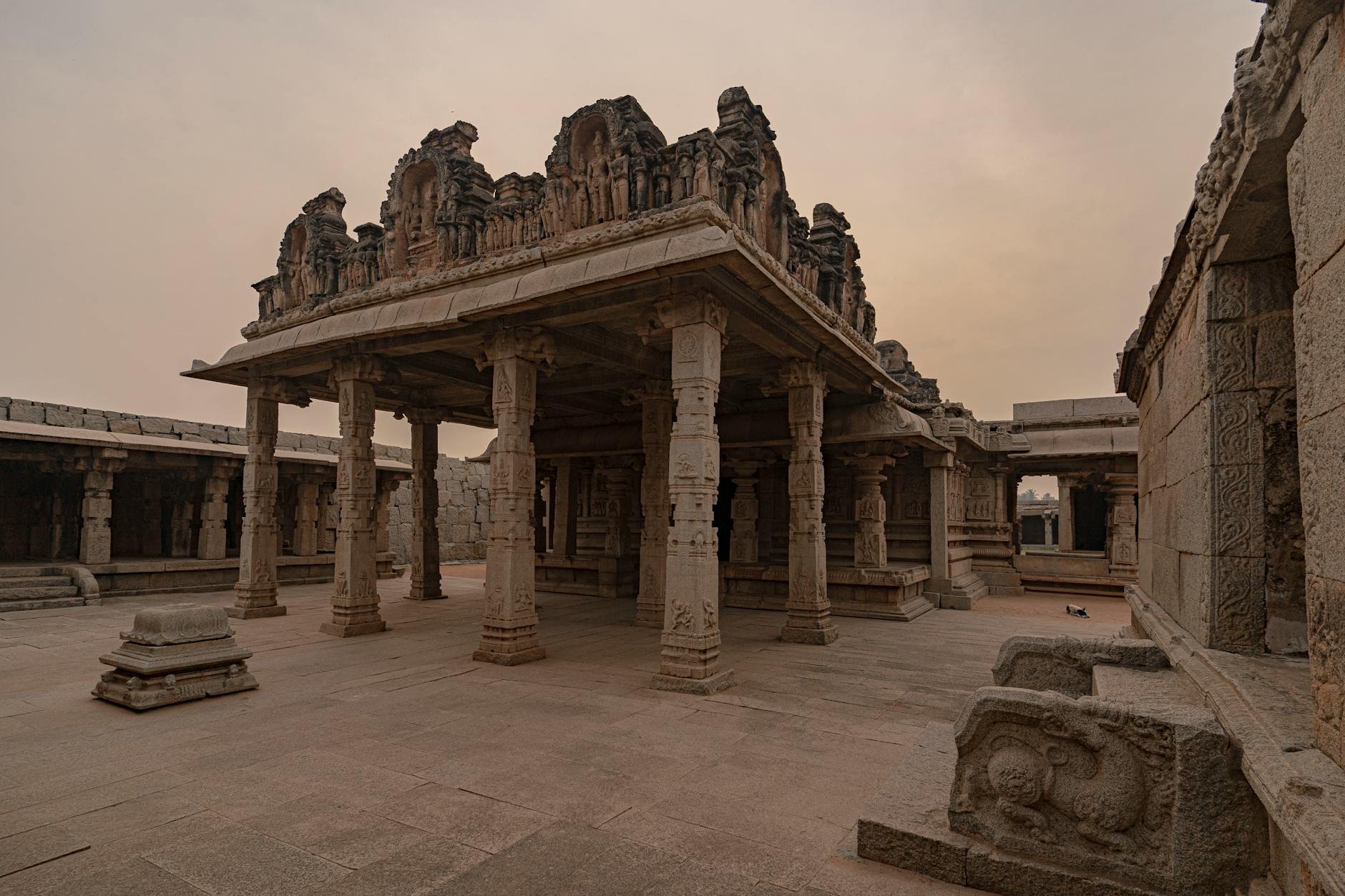
The most architecturally accomplished structure in Hampi — built in the 16th century during the empire's peak. The iconic stone chariot (one of three in India) and the 56 musical pillars (each producing different notes when tapped) are showstoppers. The temple is now de-consecrated; you can wander freely.
- Stone Chariot — featured on the ₹50 currency note
- Musical pillars (now ASI-protected from tapping)
- Maha Mandapa with 100+ carved pillars
- Battery-operated golf cart from the entrance (saves the 1 km walk)
Take the included electric buggy from the gate — it's included in your ticket and saves 30 minutes of walking each way. Tap a small pillar near the entrance (the only ones still permitted) to hear the musical resonance.
Matanga Hill Sunrise
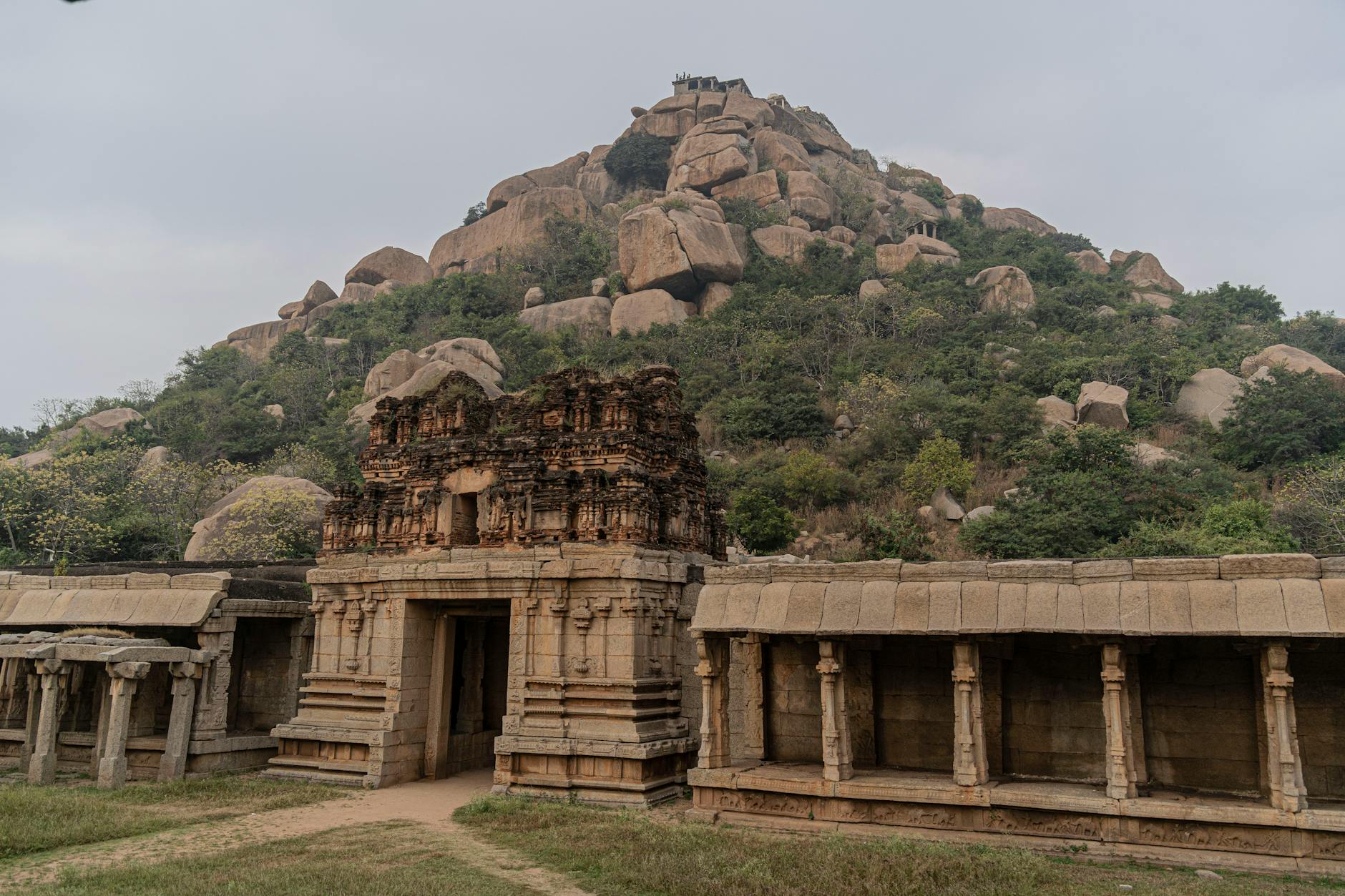
The highest point in Hampi — a 30-minute boulder-scramble climb that reveals the entire UNESCO landscape at sunrise. The Veerabhadra Temple at the top is small; the view is everything. This is the single most breathtaking moment in Hampi.
- 360° view of all of Hampi at sunrise
- Veerabhadra Temple at the summit
- Boulders glowing pink and orange
- Indistinct shapes of distant temples emerging
Start the climb 45 minutes before sunrise — bring a torch. Wear shoes with grip; the smooth rock can be slippery. Don't go alone before dawn; pair up with other travelers from your hotel. Carry water.
Hemakuta Hill — Sunset
An easier counterpart to Matanga — gentle climb up granite slabs to a cluster of pre-Vijayanagara temples. Famously the place where Shiva is said to have meditated before marrying Parvati. The sunset view across the boulder field with Virupaksha's gopuram in the foreground is the Hampi photo.
- Cluster of pre-14th-century granite temples
- Sasivekalu (mustard seed) and Kadalekalu (gram seed) Ganesha statues
- Best Virupaksha sunset photograph
- 15-min walk from Hampi Bazaar
Combine with the giant Sasivekalu Ganesha (4.5m tall, carved from a single stone) and Kadalekalu Ganesha on the same hill. Stay through sunset and pickup a hot pakora at the temporary stall at the base.
Royal Enclosure
The walled administrative core of Vijayanagara — hundreds of platform-foundations of palaces, audience halls, treasuries, and the magnificent Mahanavami Dibba (10m granite platform from which the king watched annual festivals). The level of urban planning here was unmatched in 16th-century South India.
- Mahanavami Dibba — granite platform with carved friezes
- King's Audience Hall foundation
- Stepped Tank (1985 excavation) — 5-tier swimming pool
- Public bath complex
Hire a licensed guide here (₹500–800) — without context, much of this is "just stones." A 1-hour tour explains how a sprawling capital functioned. The site is exposed; bring a hat and water.
Zenana Enclosure & Lotus Mahal
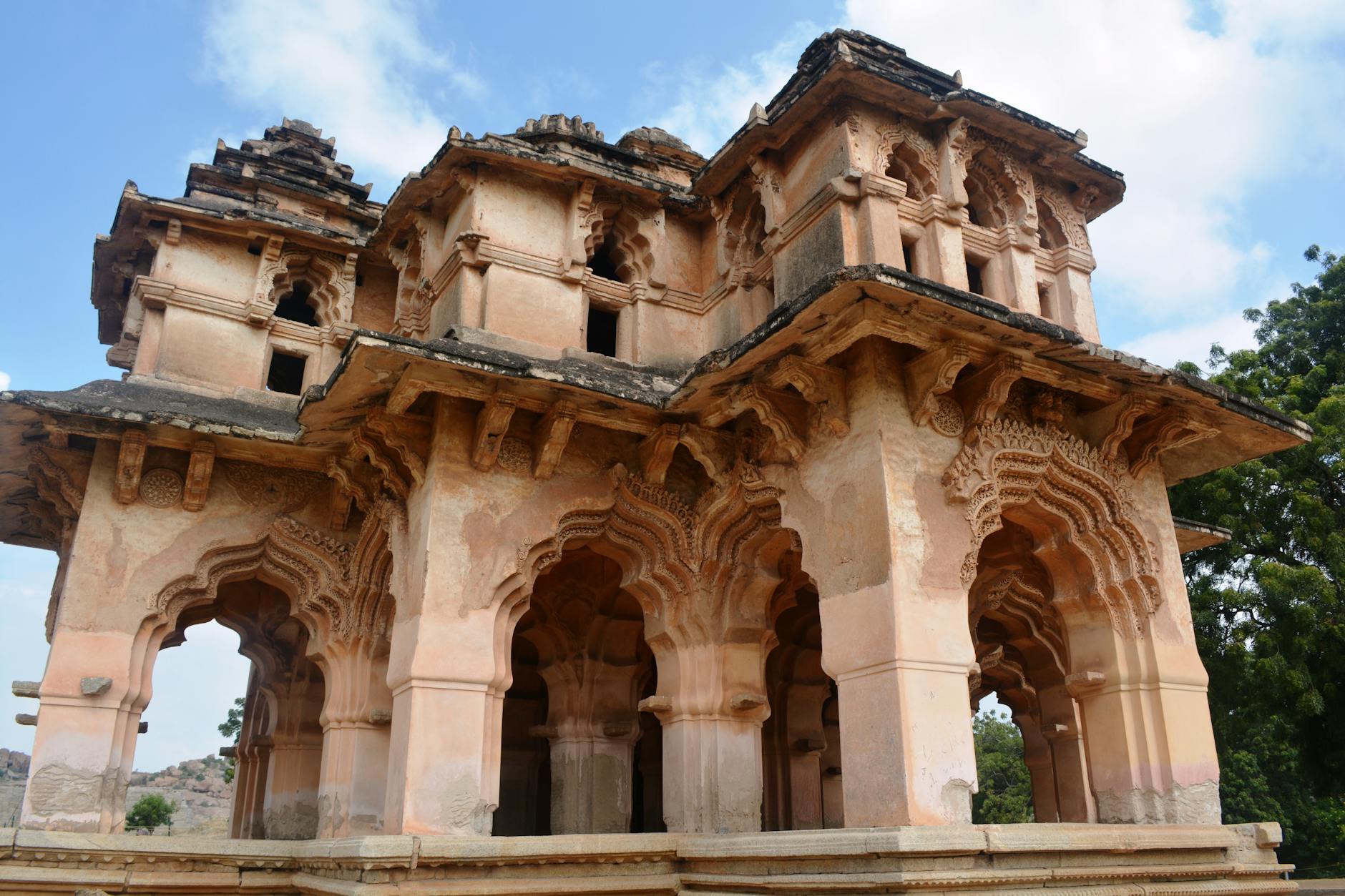
The royal women's quarters — and home to the most architecturally distinctive structure in Hampi. The Lotus Mahal's 24 pillars and lotus-bud-like dome blend Islamic Bahmani and Hindu Vijayanagara styles — a unique architectural fusion. The Elephant Stables next door are equally distinctive.
- Lotus Mahal's Indo-Islamic architecture
- Eleven domed Elephant Stables
- Watchtowers on the surrounding wall
- Treasury Building
A 5-min walk from the Royal Enclosure — combine in the same morning. The Elephant Stables are large enough to walk inside each domed cell; eerie and atmospheric in the right light.
Coracle Ride on the Tungabhadra
A coracle is a circular wickerwork boat covered in waterproofed leather (now plastic) — a 2,000-year-old design unchanged across South India. The 30-minute ride from Virupaksha's back ghat to the village across the river is the only authentic way to cross.
- River crossing in the round boat
- Banana plantations on the far bank
- Coracles spinning in eddies — the boatman corrects with a paddle
- Ferry to Anegundi village across the river
The official ferry coracle (₹20/person) crosses to Hippie Island and Anegundi 6 AM – 6 PM. After-dark crossings stop. Private "tour" coracles down the river are ₹500–1,000; the official ferry is the genuine experience.
Hippie Island & Anegundi (across the river)
Officially Virupapur Gaddi, locally "Hippie Island" — the rural side of the Tungabhadra where backpacker guesthouses, banana plantations, and the older village of Anegundi (the pre-Vijayanagara capital) lie. Hampi's mellower, more bohemian alternative to the temple side.
- Banana plantation walks
- Anegundi pre-Vijayanagara temples and tombs
- Onake Kindi viewpoint above Anegundi
- Mowgli, Goan Corner, German Bakery cafés
Stay overnight on Hippie Island for at least one night — Mowgli Resort, Goan Corner, Hema's Guesthouse. The vibe is completely different from temple-side Hampi. Last coracle back is 6 PM (during high season; check locally).
Hanuman Temple — Anjaneya Hill
The hilltop temple at Anegundi believed to be Hanuman's birthplace. 575 steps up a granite hill across the river. The view at the top — and the resident monkeys — make this a working pilgrimage site, not just a tourist viewpoint.
- 575-step climb up worn granite
- Resident monkeys (real ones, not statues)
- 360° view of the Hampi landscape
- Active temple — devotees climbing to bhajans
Don't carry food up — the monkeys are aggressive about it. Wear a hat and modest clothing (it's an active temple). Climb in late afternoon; descend before dark. Stay for sunset at Anjeyanadri — different angle from Matanga.
Bicycle or Moped Tour of the Ruins
The 26 sq km of ruins are too spread out to walk — and too compact to need a car. A bicycle (₹100/day) or moped (₹400/day) is exactly the right pace, and lets you wander into the smaller, less-visited monuments scattered between the major sites. The classic Hampi day.
- Underground Shiva Temple (Pampa Sarovar Temple)
- Krishna Temple complex
- Lakshmi Narasimha — 6.7m monolithic statue
- Pushkarani stepped tanks scattered throughout
Rent from a bike shop in Hampi Bazaar — fix the price for the whole day, not by the hour. Carry water and snacks; many smaller monuments have nowhere to refill. October–February is the only sensible cycling season; summer heat is brutal.
Suggested Itinerary
A carefully curated journey through Hampi — UNESCO Heritage's most iconic monuments and hidden gems
Sacred Hampi & Temple Side
Sunrise on the boulders, monuments, sunset on Hemakuta Hill.
Royal Hampi & Across the River
Royal Enclosure morning, coracle crossing, hilltop sunset.
Practical Guide
Getting There
By Air: Hubballi (HBX) airport is the closest at 165 km / 3.5 hours. Bangalore (BLR) is 350 km / 6 hours and has more frequent flights. Goa (GOI/GOX) is also a viable entry — 350 km / 7 hours via the scenic NH67.
By Train: Hospet Junction (HPT) is the local railhead, 13 km from Hampi. Hampi Express overnight from Bangalore (10 hr); from Goa (Hubballi-Vasco line, 8 hr); from Hyderabad (10 hr). Auto-rickshaws from Hospet to Hampi ₹150–250.
By Road: NH67 from Goa (350 km / 7 hours via Hubballi); NH48 from Bangalore (350 km / 6 hours). Most travelers combine Hampi with Goa as a 2-week southern circuit. Hampi-Hyderabad is also a popular 8-hour drive.
Getting Around
Bicycle: The defining Hampi vehicle. ₹100–150/day from any rental shop in the bazaar. Roads are flat and traffic light. Carry water.
Moped Or E Bike: For older travelers or longer days. ₹400/day for moped; ₹600/day for an e-bike. Helmet provided. Need basic license but checks are rare.
Auto Rickshaw: Available from Hospet station and around Hampi Bazaar. ₹500–1,200 for a half-day private hire covering most monuments. Useful if cycling isn't your thing.
Coracle: For the river crossing only. Official ferry runs 6 AM – 6 PM. ₹20 per person. The longest queue is at sunset; cross earlier if possible.
Where to Stay
- Hampi Village (Sacred Side) — Budget guesthouses near Virupaksha Gopi Guesthouse, Padma Guesthouse, Kishkinda Heritage Resort. ₹500–4,000. Walking access to all temples; basic but atmospheric.
- Hippie Island / Virupapur Gaddi — Bohemian backpacker guesthouses Mowgli Resort, Goan Corner, Hema's Guest House. ₹600–3,000. Banana plantations, river views, mellower vibe. Coracle crossing every day.
- Hospet (13 km from Hampi) — Modern hotels for groups, families Hyatt Place Hampi (yes, really), Royal Orchid Central Kireeti. ₹4,000–12,000. Comfortable but soulless; daily auto/taxi to Hampi.
- Anegundi village — Restored heritage homestays Uramma Heritage Homes, Champa Heritage. ₹3,500–8,000. Atmospheric experience of pre-Vijayanagara village life; quiet, distinctive.
Day Trips & Nearby
- Badami, Aihole, Pattadakal — 3 hr (140 km) The Chalukya capital triangle — older than Vijayanagara (5th–8th century). Pattadakal is UNESCO-listed and arguably the most important early Hindu temple site in India. Day trip with early start.
- Bijapur (Vijayapura) — 4 hr (215 km) The Adil Shahi sultanate capital — Gol Gumbaz has the world's second-largest dome. Combine with Badami as a 2-day Karnataka heritage circuit.
- Daroji Sloth Bear Sanctuary — 30 min (15 km) India's only sanctuary dedicated to sloth bears. Best at dusk when bears emerge for termite-mounds. Easy half-day add-on from Hampi.
- Tungabhadra Dam — 20 min (8 km from Hospet) 1953-built dam with sunset views, gardens, and a small musical fountain show. Family-friendly add-on for those staying in Hospet.
Gallery
Travel Tips
Sunrise: Climb Matanga Hill before dawn — the sunrise over Hampi's boulders is unforgettable.
Cycling: Rent a bicycle (₹100/day) — the ruins are spread out and roads are flat.
Stay: Hippie Island (across the river) has budget guesthouses with incredible views.